
When people talk about “superannuation tax changes”, they often mean three different things: changes to the Superannuation Guarantee (SG) rate, changes to when super must be paid, and changes to tax concessions for larger balances. Each affects different groups, and the practical impact depends on whether you’re an employee, an employer, or running your own super strategy.

Below is a plain-English summary of the key changes and what they might mean for your admin and planning.
1) SG rate updates: the contribution baseline is now 12%
The SG rate is the minimum super contribution employers must pay for eligible employees. The ATO publishes the SG schedule, including the percentage (see ATO: Super guarantee).
From 1 July 2025, the SG rate increases to 12% (see ATO: The final SG rate increase is coming on 1 July). This matters for:
- Employees: higher contributions (all else equal), which improves compounding over time.
- Employers: higher payroll costs and a bigger penalty exposure if super is underpaid.
- Contractors paid as employees: many arrangements that look “contractor-like” are still SG eligible in practice, so classifications should be reviewed.
If your payroll system hasn’t been updated for the new SG rate, errors can quietly accumulate. A quarterly catch-up can still be expensive once Superannuation Guarantee Charge applies.
2) Payday Super: a major compliance shift from 1 July 2026
Payday Super is one of the biggest operational changes in years. The policy requires employers to pay SG at the same time as salary and wages, so contributions reach the employee’s nominated account within a short timeframe after payday (see ATO: Payday superannuation and Fair Work: Payday super new rules).
Payroll and cash flow impacts
For businesses, the change isn’t only “more frequent payments”. It pushes payroll hygiene to the front:
- Ordinary Time Earnings (OTE) mapping must be correct (allowances vs overtime)
- New starters need their fund details captured quickly
- Exceptions need active monitoring (missed pay runs, manual adjustments)
- Cash flow forecasting becomes more granular

If you lodge BAS regularly, you already know the value of clean reconciliation. The same discipline applies here. Our practical BAS process guides can help tighten your monthly rhythm: BAS Lodgement Simplified and Online BAS Lodgement: 5 steps.
3) Better targeted tax concessions for very large super balances
Another category of superannuation tax changes is aimed at very large balances. The Government has published measures to reduce tax concessions for earnings associated with total superannuation balances above $3 million from 1 July 2026 (see ATO: Better targeted superannuation concessions and Treasury: Better targeted superannuation concessions).
This is not something most people will ever encounter. But for high-balance individuals, it may influence contribution strategy, asset allocation inside and outside super, and how thresholds are managed over time.
4) What these changes mean for SMSFs
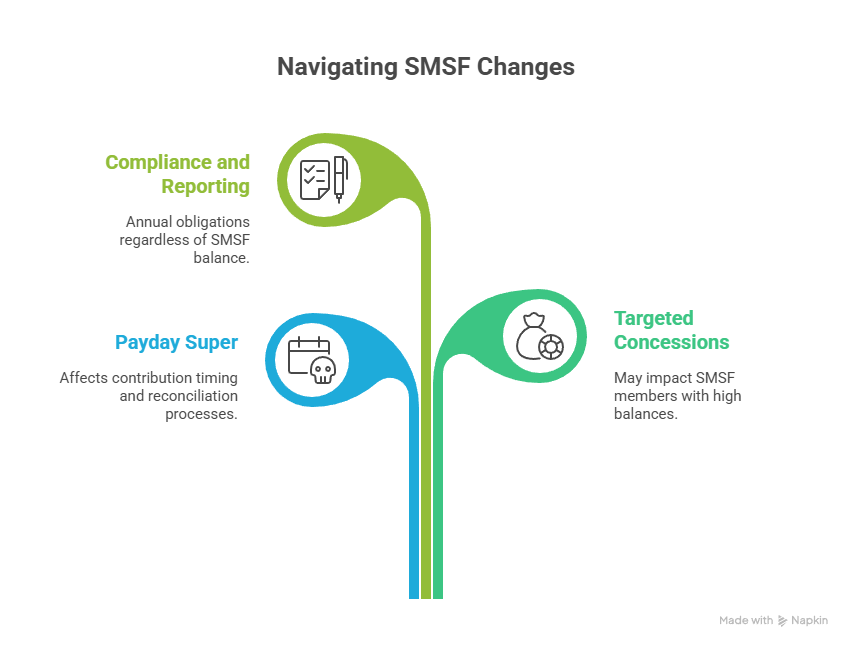
If you run a self-managed super fund (SMSF), these changes can still affect you indirectly. Payday Super affects contribution timing and reconciliation, and targeted concessions may affect some SMSF members with high balances. SMSFs also have annual compliance and reporting obligations regardless of balance (see ATO: Lodge SMSF annual returns).
If you want a practical refresher on SMSF responsibilities, see What is a Self Managed Super Fund? and Set Up a Self-Managed Super Fund (SMSF): Step-by-Step.
A “next 30 days” checklist for employers and employees
To keep these superannuation tax changes from becoming a last-minute scramble, pick a small action depending on your role.
If you’re an employer:
- Confirm SG rate settings are correct for all pay items
- Audit OTE mapping for allowances and variable pay
- Review your SuperStream / clearing house workflow and exception handling
- Start planning for Payday Super (systems, staff training, cash flow)
If you’re an employee:
- Check your payslip super line and fund details
- Review your annual statement for fees and insurance premiums
- Consolidate duplicate accounts if appropriate (after checking insurance)
- If salary sacrificing, track total concessional contributions
The takeaway
Super changes often look technical, but the impact is practical: higher SG, tighter timing, and new rules for very large balances. If you treat super as a process—with clean payroll data and a simple review cadence—you avoid most problems before they start. Contact TTS & Associates and we can help with your superannuation questions.
General information only – seek professional advice before acting.